
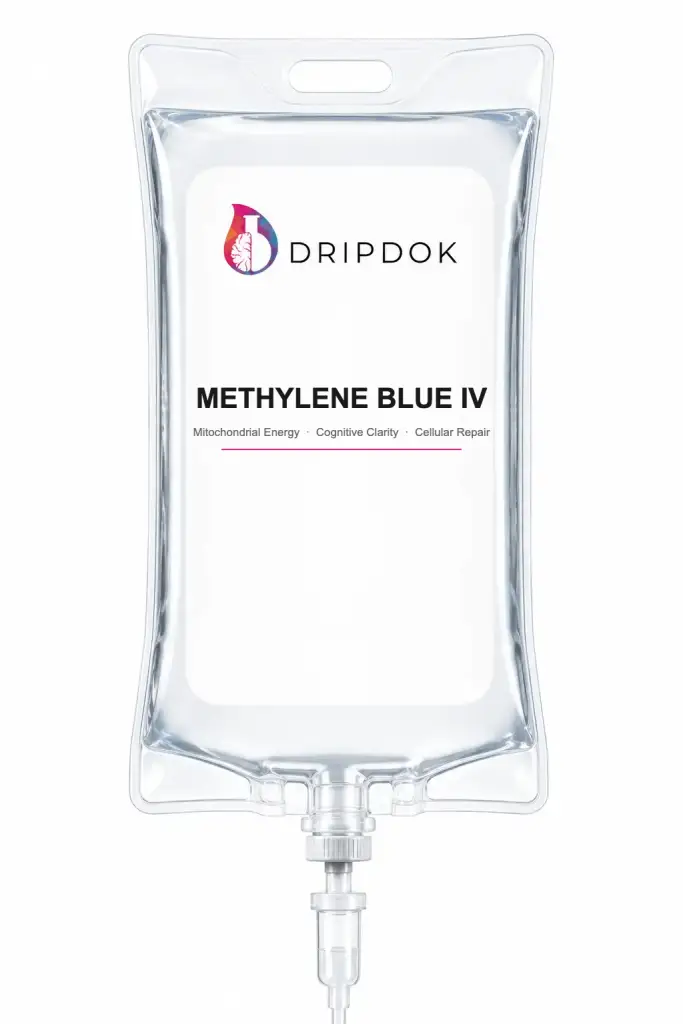
MITOCHONDRIAL ETC PROTOCOL
Methylene Blue IV | Mitochondrial ETC Protocol
Advanced mitochondrial electron transport chain activator. A titrated-dose IV infusion of pharmaceutical-grade methylene blue — penetrating the blood-brain barrier for direct neurological and cognitive action. Physician-reviewed. Nurse-administered. Cold-chain sourced.
50–500 mL
Infusion volume per session
100%
Bioavailability via IV delivery
20–90 min
Typical session duration
METHYLENE BLUE FORMULA
Titrated Mitochondrial & Neuroprotection Protocol
Each component is selected for physiological relevance and enzymatic function — not marketing appeal.
MB
Methylene Blue (Methylthioninium Cl)
Pharmaceutical-grade methylene blue (methylthioninium chloride) at titrated concentration (0.5–2 mg/kg). Acts as an alternative electron carrier within mitochondrial complexes I and IV. Bypasses dysfunctional ETC nodes.
D5W
5% Dextrose (Low-Dose Vehicle)
5% Dextrose in Water (D5W) used as vehicle for low-dose MB protocols. Dextrose supports cellular energy substrate availability and reduces the risk of methylene blue precipitation in hypotonic solutions.
B12
Hydroxocobalamin (Neuroprotection)
Hydroxocobalamin (B12) provides neuroprotection synergy with methylene blue. Supports myelin maintenance, mitochondrial one-carbon metabolism, and homocysteine regulation — contraindicated with cyanocobalamin in MB protocols.
ALA
Alpha-Lipoic Acid (Co-Antioxidant)
Alpha-Lipoic Acid (ALA) at 300–600mg provides antioxidant synergy with methylene blue. Reduces methylene blue-associated oxidative metabolites, supports mitochondrial membrane potential, and enhances Complex II electron transfer.
MgSO₄
Magnesium Sulphate (Neuro Cofactor)
Magnesium Sulphate (MgSO₄) provides neurological cofactor support. Magnesium is required for ATP synthesis stability and protects against MB-induced excitotoxicity at higher doses. Supports smooth muscle relaxation and nerve conduction.
GSH
Glutathione (Redox Partner)
Glutathione (GSH 600mg) serves as the primary redox partner to methylene blue. MB cycles between its oxidised (methylene blue) and reduced (leucomethylene blue) forms — GSH maintains this cycling efficiently while quenching reactive oxygen species.
CLINICAL BENEFITS
Targeted Cellular Mechanisms
Methylene Blue IV activates mitochondrial complexes I–IV by acting as an alternative electron carrier — directly restoring ATP synthesis efficiency in dysfunctional mitochondria. Each dose is physician-calibrated based on weight and clinical indication, targeting the precise plasma concentration required for CNS penetration and cognitive enhancement without MAO inhibition risk.
01
Complex I & IV ETC Bypass
Methylene blue inserts directly into the mitochondrial electron transport chain at Complex I and IV, bypassing blocked or dysfunctional electron transfer nodes. This restores ATP production in cells where conventional substrates have failed.
02
Cytochrome C Oxidase Upregulation
At therapeutic IV concentrations, methylene blue crosses the blood-brain barrier and upregulates cytochrome C oxidase (Complex IV) — the rate-limiting enzyme of mitochondrial respiration. Associated with measurable improvement in cognitive processing speed and memory consolidation in published clinical data.
03
MAO Inhibition & Serotonin Modulation
Methylene blue inhibits MAO-A and MAO-B at mid-to-high doses, modulating serotonin and dopamine degradation. This mechanism supports mood regulation, post-viral neurological fatigue recovery, and neuroprotection against amyloid-beta-induced mitochondrial dysfunction.
04
Cerebral Blood Flow Enhancement
IV methylene blue enhances cerebral blood flow via nitric oxide modulation and vascular smooth muscle relaxation. Improved cerebrovascular perfusion supports oxygen and glucose delivery to neural tissue — contributing to the cognitive clarity reported across protocols.
PROTOCOL COORDINATION
How Each Session is Confirmed
01
Select Date, Time & Service
Submit your preferred service, date, and time. Your Patient Relations (PR) coordinator reviews availability and logistics — PR handles operational scheduling, not clinical decisions.
02
Secure Payment & Intake Form
A payment link is sent via Wise, Stripe, or local transfer. Advance payment is required to confirm the booking. Upon payment, you receive a patient consent and medical intake form to complete.
03
Physician Review & Confirmation
Your physician reviews the intake form for clinical suitability and safety. Once approved, your appointment is formally confirmed. Standard protocols require 24–48 hours advance notice for nurse scheduling and cold-chain preparation.
Begin Your Protocol
Physician-reviewed IV therapy, delivered to your location across Bali. Your Patient Relations team coordinates scheduling, payment, and confirmation. Standard protocols require 24–48 hours advance notice. Request your session below.
Begin Your Methylene Blue Protocol
Physician-guided IV therapy, delivered to your door. Available across Bali — Canggu, Seminyak, Ubud, Kuta, Nusa Dua, and beyond. 24–48 hours advance notice required.
AT-HOME IV THERAPY — BALI
Methylene Blue IV Protocol
Pharmaceutical-grade methylene blue in a precision-titrated IV protocol. Mitochondrial electron transport chain activation, BBB-crossing neuroprotection, and redox restoration — physician-reviewed, nurse-administered, delivered to your Bali location.
THE SCIENCE
Mitochondrial ETC Activation & Neuroprotection
Methylene blue acts as an alternative electron carrier within mitochondrial complexes I–IV, rerouting electrons around dysfunctional segments and restoring ATP synthesis efficiency. Intravenous delivery achieves plasma concentrations sufficient to cross the blood-brain barrier — enabling direct neurological action at doses that oral supplementation cannot achieve. Clinical evidence supports roles in cognitive enhancement, Alzheimer's risk reduction, mood regulation (via MAO-A/B modulation), and post-viral neurological fatigue recovery.
WHAT'S INSIDE
Methylene Blue IV Composition
IV Vehicle
0.9% Sodium Chloride or 5% Dextrose in Water (D5W), 50–500 mL — pharmaceutical-grade isotonic carrier. Volume titrated per dose and protocol tier.
Methylene Blue (Methylthioninium Chloride)
USP-grade methylene blue at titrated concentration (0.5–2 mg/kg). Acts as an alternative electron carrier in the mitochondrial electron transport chain — directly donating electrons to cytochrome c, upregulating Complex IV (cytochrome c oxidase), and restoring NAD⁺/NADH redox balance. Crosses the blood-brain barrier in intravenous form.
OAT Clearance
Organic anion transporter (OAT) screening is required for mid and high-dose protocols. MAO inhibitor contraindications must be confirmed absent before administration. Physician review required every session.
Protocol concentration is clinically determined by physician intake assessment. Formulation may be adjusted based on individual contraindication profile, body weight, and prior response. All sessions require physician pre-approval.
CLINICAL INDICATION
Protocol Suitability
01
Cognitive Enhancement & Neuroprotection. Individuals experiencing cognitive fatigue, early neurological decline, post-viral cognitive impairment (long-COVID), or seeking preventive neuroprotection. Methylene blue enhances mitochondrial ATP output in neurons, supports BDNF-related pathways, and reduces oxidative stress at the synaptic level.
02
Mitochondrial Dysfunction & Chronic Fatigue. Those with documented mitochondrial dysfunction, chronic fatigue syndrome, or metabolic inefficiency. IV methylene blue bypasses impaired Complex I and III activity, restoring downstream electron flow and ATP production without reliance on dysfunctional enzyme complexes.
03
Longevity & Cellular Redox Optimization. Individuals pursuing a diagnostics-informed anti-aging approach. Methylene blue's redox cycling properties neutralize reactive oxygen species, support mitochondrial membrane potential, and complement NAD+ and peptide-based longevity protocols. OAT clearance required.
CLINICAL OUTCOMES
Observed Treatment Responses
Cognitive Clarity & Processing Speed
Enhanced mental processing, reduced cognitive fog, and improved working memory — attributed to increased neuronal ATP availability, reduced oxidative burden, and cytochrome c oxidase upregulation. Onset typically within 24–72 hours post-infusion.
Energy Restoration & Mitochondrial Efficiency
Reduction in fatigue driven by restoration of electron transport chain efficiency. Methylene blue reroutes electrons around dysfunctional complexes, enabling ATP synthesis to continue where conventional pathways are impaired. Effects are sustained, not stimulant-mediated.
Neuroprotection & Mood Regulation
Reduced neuroinflammatory markers and improved mood stability — supported by methylene blue's documented MAO-A/B modulation, antioxidant activity in neural tissue, and anti-amyloid aggregation properties. Individual responses vary based on baseline neurological status.
Clinical outcomes are individual and may vary based on baseline neurological status, contraindication profile, and protocol frequency. These are reported observations, not therapeutic guarantees. Methylene blue does not constitute medical treatment for any specific condition. All sessions are physician-reviewed for safety and clinical appropriateness prior to confirmation.
WHY DRIPDOK
A Physician-Founded System. Not an IV Menu.
DripDok was established in 2017 by a US-trained physician with academic foundations in molecular genetics, analytical chemistry, and biotechnology — and is associated with research through Purdue, Harvard, MIT, and Michigan State University. As the first clinic in Southeast Asia to offer advanced NAD+ IV protocols, DripDok operates as a precision medicine system, not a retail infusion bar. Every protocol is governed by diagnostic-first methodology, cold-chain sourcing standards, and formal physician oversight — applied to every client, every session.
BEGIN YOUR PROTOCOL
How to Book a Session
Your Patient Relations team coordinator reviews your request and sends a secure payment link via Wise, Stripe, or local transfer. After payment, you complete a medical intake and consent form. Your physician reviews it for clinical suitability, then confirms your appointment. Standard protocols require 24–48 hours advance notice for nurse scheduling and cold-chain preparation.